
Anonymous 10/24/26 (Sat) 11:42:01 2b024c (10) No.25172993
More than 93 years after the Holy See signed an agreement with Adolf Hitler's government, the Reichskonkordat remains legally valid in modern Germany. Its survival raises questions about political compromise, religious authority, and the lasting consequences of agreements made with authoritarian regimes.\
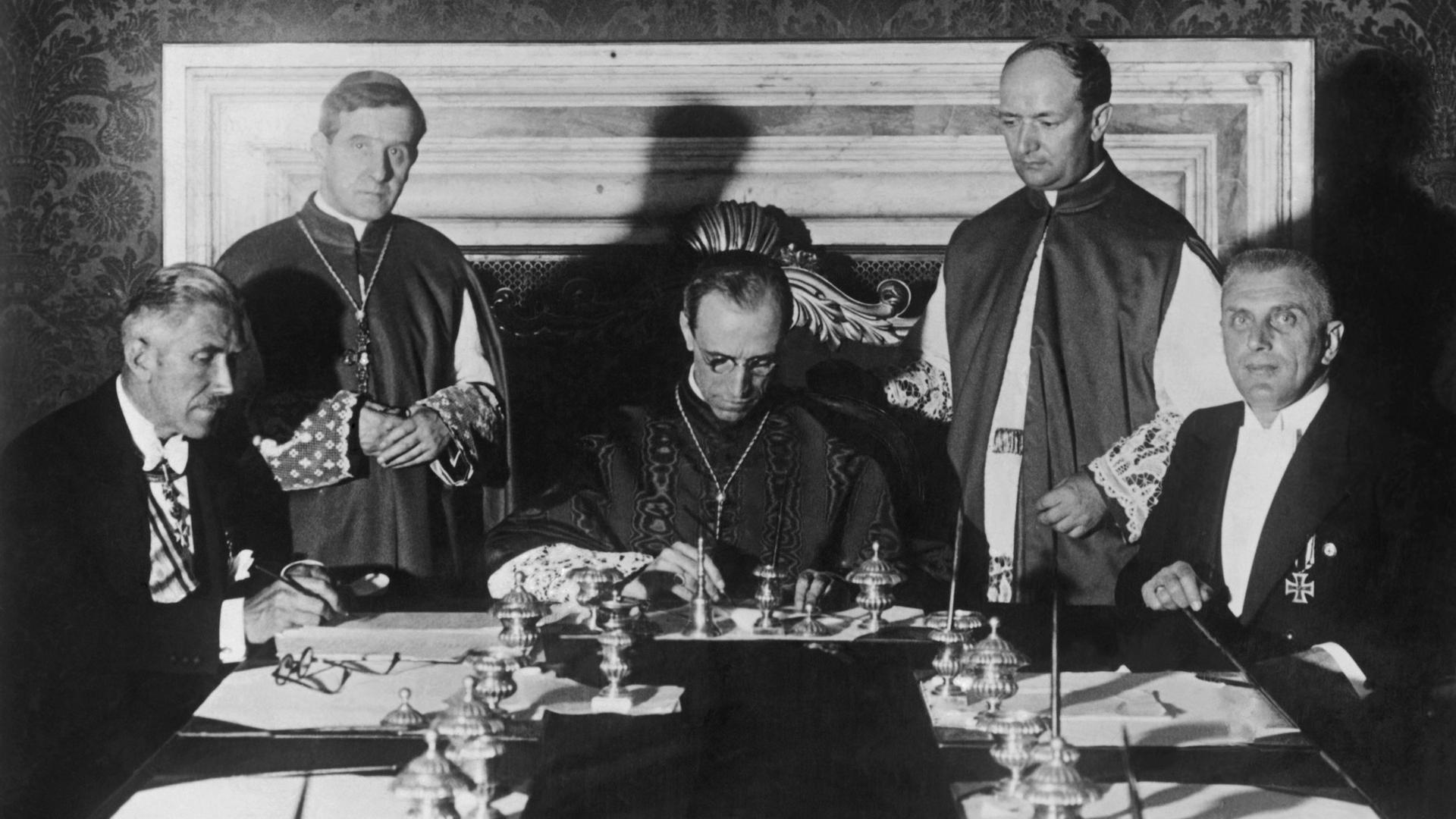
Historical photograph of the Reichskonkordat signing, July 20, 1933. Source: German History in Documents and Images.
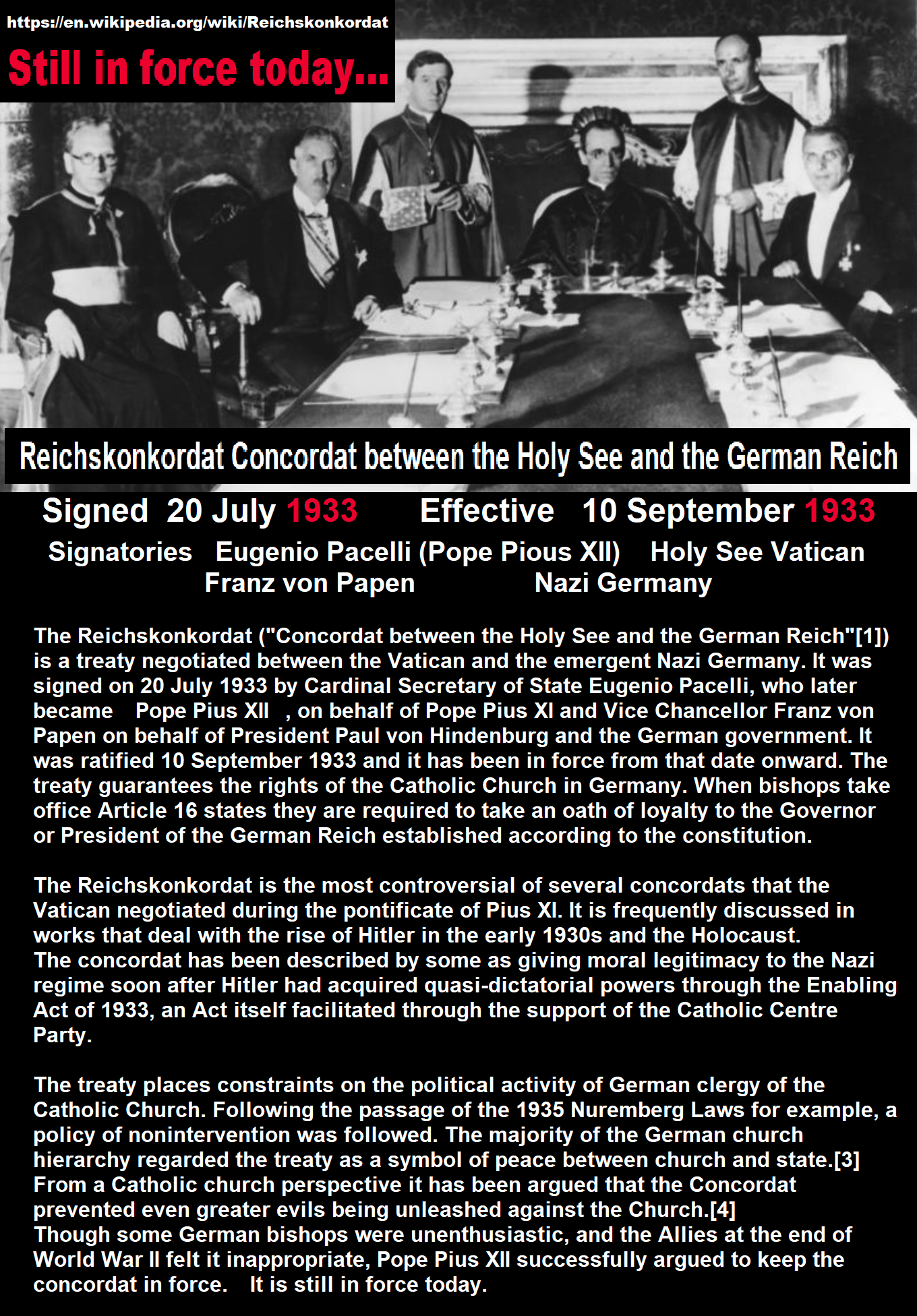
On July 20, 1933, representatives of the Vatican and Nazi Germany signed an agreement that would become one of the most controversial diplomatic arrangements in modern religious history.
Known as the Reichskonkordat, the treaty established formal protections for the Catholic Church in Germany while placing restrictions on the political activities of Catholic clergy.
The agreement was signed just months after Adolf Hitler became Germany's chancellor and began dismantling the country's democratic institutions.
Representing the Vatican was Cardinal Eugenio Pacelli, the future Pope Pius XII. Representing Germany was Vice Chancellor Franz von Papen, acting on behalf of President Paul von Hindenburg.
The agreement entered into force on September 10, 1933.
What makes this treaty especially remarkable is that it was never formally abolished following Nazi Germany's defeat in 1945. More than nine decades later, it remains part of Germany's legal framework governing relations with the Catholic Church.
German History in Documents and Images
+1
The continued existence of this agreement is not a conspiracy theory or an unverified historical claim. It is documented by the Vatican, German historical institutions, and Germany's Federal Constitutional Court.
The more difficult questions concern why the agreement was signed, what both parties gained, and whether the Vatican's effort to protect the Church came at an unacceptable political cost.
A treaty signed as Hitler consolidated power
When Hitler became chancellor on January 30, 1933, Germany was still formally governed under the Weimar constitutional system.
Within months, however, the Nazi government had begun systematically removing the country's democratic safeguards.
The Reichstag Fire Decree of February 1933 suspended major civil liberties. In March, the Enabling Act gave Hitler's government sweeping legislative authority without ordinary parliamentary approval.
Political opponents faced intimidation, arrest, and persecution.
By July 1933, Germany was rapidly becoming a one-party dictatorship.
It was against this backdrop that Vatican officials negotiated an agreement with the new government.
The Catholic Church represented a substantial portion of Germany's population and maintained schools, charitable institutions, religious organizations, and political influence.
The Nazis understood that the Church represented an institution with loyalties and authority outside direct government control.
For Vatican officials, the treaty offered a possible way to preserve the Church's independence and its right to operate inside Germany.
For Hitler's government, the agreement offered something equally significant: international recognition and a reduction in organized Catholic political opposition.
The German Historical Institute's documentation describes the concordat as a source of international prestige for the Nazi regime and a means of temporarily reducing opposition from the Church.
German History in Documents and Images
What did the Vatican agree to?
The Reichskonkordat contained 34 articles addressing religious freedom, church administration, education, property rights, clergy appointments, and relations between the Church and the German state.
Several provisions deserve particular attention.
Article 1: Religious freedom
Germany formally guaranteed freedom for the public practice of Catholicism and recognized the Church's right to administer its own affairs within the law.
Article 16: Loyalty to the German state
The treaty required newly installed Catholic bishops to swear an oath of loyalty to the German Reich and to respect its constitutionally established government.
This is significant because the government holding power in July 1933 was already controlled by Hitler's National Socialist regime.
The oath did not explicitly require allegiance to Hitler personally or acceptance of Nazi ideology. Nevertheless, it established a formal expression of loyalty to the German state during a period of rapidly expanding dictatorship.
Article 21: Religious instruction
The treaty recognized Catholic religious education as part of the school system, subject to its provisions.
Article 32: Political restrictions
Perhaps the most politically consequential provision was Article 32.
It committed the Holy See to establish rules excluding Catholic clergy and members of religious orders from political-party membership and activities on behalf of political parties.
At a time when Hitler was eliminating competing political organizations, this provision further restricted the Church's involvement in organized party politics.
The treaty therefore represented more than a religious agreement. It involved a political compromise at a critical moment in Germany's transformation into a dictatorship.
German History in Documents and Images
+1
The disappearance of Catholic political opposition
One of the most disputed elements of the Reichskonkordat concerns the Catholic Centre Party.
For decades, the Centre Party had been an important political voice for German Catholics.
In March 1933, its parliamentary representatives supported the Enabling Act, which granted Hitler's cabinet extraordinary lawmaking powers.
The party dissolved on July 5, 1933, fifteen days before the Reichskonkordat was signed.
Its dissolution occurred amid the Nazis' broader destruction of political opposition.
The precise relationship between Vatican negotiations and the Centre Party's decisions remains disputed among historians.
It would be inaccurate to claim that Article 32 directly dissolved the Centre Party because the organization had already disbanded before the treaty's signing.
However, the agreement formalized a separation between Catholic clergy and party politics that aligned with Hitler's effort to eliminate independent centers of political power.
German historical records indicate that Hitler regarded the withdrawal of Catholic political influence as an important advantage of the negotiations.
German History in Documents and Images
The fundamental question remains: Did the Vatican believe it was securing necessary protections for German Catholics, or did those protections come at the expense of political resistance to an emerging dictatorship?
The available evidence supports the existence of both the Vatican's protective objectives and the Nazi government's political advantages.
It does not establish that Vatican leaders endorsed every objective of National Socialism.
A promise the Nazi government repeatedly violated
The safeguards written into the Reichskonkordat did not prevent the Nazi regime from interfering with Catholic institutions.
In the years following the agreement, the government restricted Catholic organizations, pressured religious schools, and persecuted members of the clergy.
These actions undermined the protections the Vatican had negotiated.
By 1937, tensions had escalated sufficiently that Pope Pius XI issued the encyclical Mit brennender Sorge, translated as With Burning Concern.
The document, dated March 14, 1937, criticized Nazi policies, condemned violations of the concordat, and rejected attempts to elevate race, state authority, or national identity above religious and moral principles.
It was distributed secretly and read in Catholic churches throughout Germany.
The Vatican's own published text makes clear that Church leaders considered the German government responsible for repeated violations of the treaty.
Vatican
This episode is essential to understanding the historical record.
The Vatican's decision to sign the agreement in 1933 did not mean relations between the Church and the Nazi government remained cooperative throughout Hitler's rule.
At the same time, subsequent opposition to Nazi policies does not erase the political benefits the regime obtained from the original agreement.
Both historical realities must be considered.
Why is the treaty still in force today?
THE LEGAL QUESTION
The survival of the Reichskonkordat after World War II is one of the agreement's most unusual features.
When Nazi Germany collapsed in May 1945, the country's government and political institutions underwent major changes.
But the collapse of a government does not automatically terminate every international agreement previously entered into by the state.
After the creation of the Federal Republic of Germany in 1949, officials faced legal questions concerning agreements inherited from earlier German governments.
In 1957, the German Federal Constitutional Court examined the Reichskonkordat in a dispute involving public education.
Its decision of March 26, 1957, recognized the agreement's continued legal relevance within the constitutional framework of postwar Germany.
However, the ruling also established important limits concerning the responsibilities of Germany's federal states and the application of treaty provisions governing education.
The court did not hold that every provision of the 1933 agreement automatically superseded modern constitutional authority.
Federal Constitutional Court
+1
Today, the Reichskonkordat continues to form part of the legal relationship between the Catholic Church and the German state.
Its provisions operate alongside Germany's Basic Law, subsequent agreements, and modern constitutional requirements.
The original treaty's continued legal status does not mean that the Nazi government still exists, that Germany remains governed by Nazi law, or that the Vatican maintains an alliance with Hitler's regime.
Those interpretations would misrepresent the legal meaning of the treaty's survival.
What remains is an international agreement concluded during the Nazi era that was carried forward into Germany's postwar legal system.
Religious protection or political compromise?
The Vatican's defenders argue that the Reichskonkordat was an attempt to preserve religious freedom under an increasingly hostile government.
From this perspective, Church leaders faced a difficult situation: negotiate protections while the opportunity existed, or risk losing the legal ability to operate schools, churches, and charitable organizations.
Critics argue that the treaty granted diplomatic credibility to Hitler's government at a crucial moment.
The agreement also limited the political activities of clergy as the Nazis eliminated competing organizations and consolidated state power.
These interpretations are not necessarily mutually exclusive.
The Vatican could have pursued legitimate institutional protections while simultaneously making concessions that benefited an authoritarian government.
Indeed, that possibility lies at the center of the historical controversy.
The question is not simply whether the Vatican supported or opposed Nazism. The historical record is more complicated.
It concerns the consequences of diplomatic compromise, the responsibilities of religious institutions under authoritarian rule, and the difference between protecting an organization and confronting political injustice.
What does the treaty's survival tell us today?
The continued existence of the Reichskonkordat raises a broader question about historical accountability.
How should modern democratic governments handle agreements inherited from authoritarian regimes?
The fact that an agreement was signed under a dictatorship does not necessarily make every provision illegitimate.
Likewise, continued legal recognition does not erase the conditions under which an agreement was negotiated.
The Reichskonkordat illustrates how treaties can outlive the governments that created them.
It also demonstrates the importance of examining diplomatic agreements beyond their stated purposes.
Who received protection? Who surrendered political influence? What advantages did the government gain? And what consequences followed?
These questions remain relevant whenever powerful institutions negotiate with governments accused of suppressing political and religious freedom.
Conclusion: A documented agreement with a complicated legacy
The Reichskonkordat is not a hidden treaty.
Its original provisions are publicly available through the Vatican's archives. Its political history is documented in German historical collections. Its continued legal status has been addressed by Germany's highest constitutional court.
The essential facts are established.
The Vatican signed a treaty with Nazi Germany on July 20, 1933.
The agreement promised protections for the Catholic Church while restricting clergy participation in political parties.
Hitler's government benefited from the diplomatic recognition and political consequences of the agreement.
The Nazi regime subsequently violated important treaty provisions, prompting public condemnation from Pope Pius XI.
And despite Nazi Germany's defeat in 1945, the agreement remains legally relevant in Germany today.
None of these facts proves that the modern Vatican supports Nazi ideology. But they do establish that the Holy See entered a consequential political agreement with Hitler's government during the earliest months of the Nazi dictatorship.
Understanding that agreement requires neither excusing the Vatican's choices nor exaggerating what the historical evidence demonstrates.
It requires examining the documented record, identifying the concessions made by each side, and recognizing that institutional decisions can have consequences far beyond the circumstances in which they were made.
The Reichskonkordat remains a historical example of the difficult relationship between religious authority, state power, and political responsibility.
And more than nine decades after its signing, that history remains relevant.
Sources and historical documentation
- Vatican Archives: Reichskonkordat — Original Treaty, July 20, 1933. Primary document containing the complete treaty.
- German Historical Institute: Reich Concordat — Historical Background and English Translation. Historical context and treaty provisions.
- Vatican: Pope Pius XI — Mit brennender Sorge, March 14, 1937. Primary source documenting Vatican objections to Nazi policies and treaty violations.
- German Federal Agency for Civic Education: Vatican and German Reich Sign the Reichskonkordat. Historical analysis of the agreement and its postwar status.
- German Federal Constitutional Court: Decision of March 26, 1957 — Case 2 BvG 1/55. Legal ruling concerning the concordat's standing within Germany.
SHARE THIS RECORD
IN BRIEF
What to take away
The Vatican's 1933 Agreement With Nazi Germany: A Treaty That Remains in Force Today
Follow the sources, not just the headline.
Keep the timeline and context in view.
ABOUT THIS RECORD
QNotables newsroom
Research, source tracking, and public-record context for readers who want the full picture.
KEEP READING


COMMENTS
No comments yet. Be the first to comment!
You must be logged in to leave a comment.
LOG IN TO COMMENT