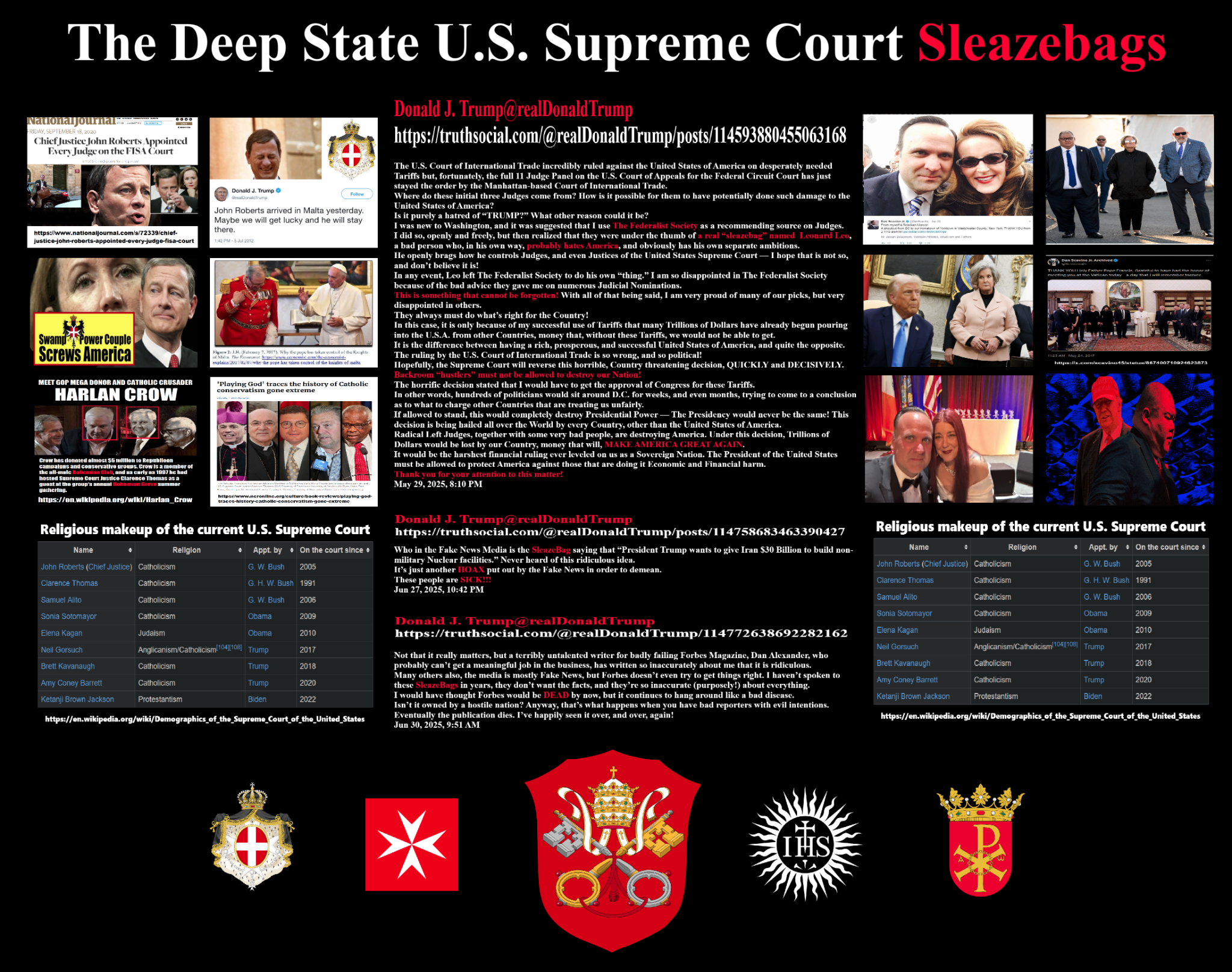
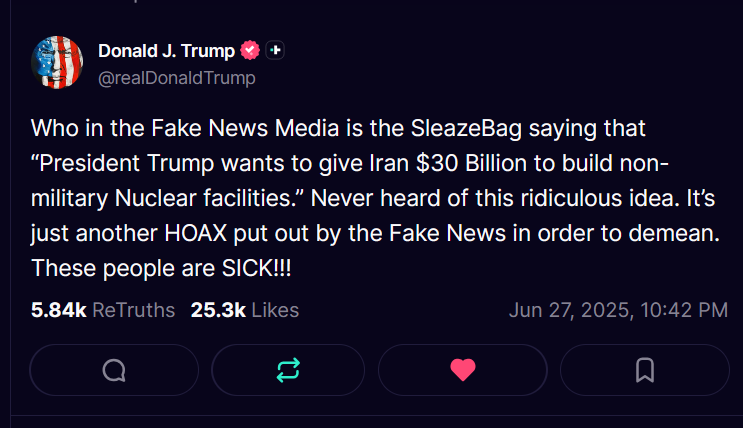
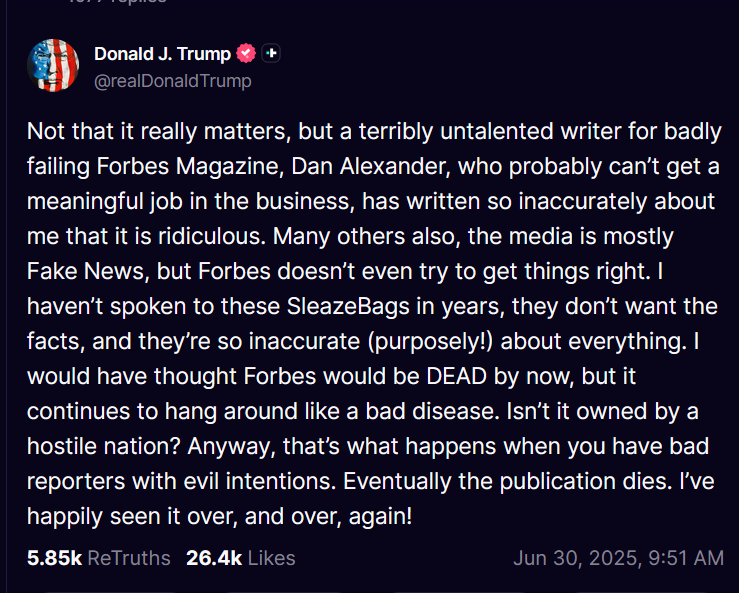
I extracted three post identifiers directly from the image.
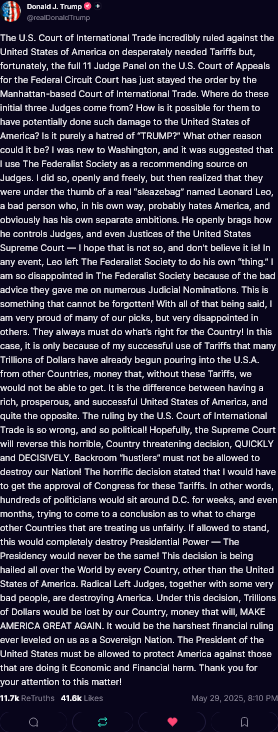
Post 1 — May 29, 2025
The main post discusses the U.S. Court of International Trade's ruling against Trump's tariffs and attacks the judiciary over its handling of the administration's economic policies.
Verification: All three posts are independently documented in the American Presidency Project archive and Trump's Truth archive. The post identifiers, dates, and subject matter match the image.
In the May 29 post, Trump explicitly named Leonard Leo and criticized the Federalist Society for its recommendations regarding federal judicial appointments.
Trump also alleged that Leo had influence over judges and Supreme Court justices, while acknowledging uncertainty about the extent of that influence.
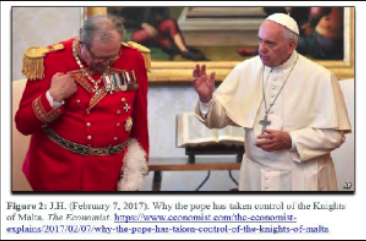
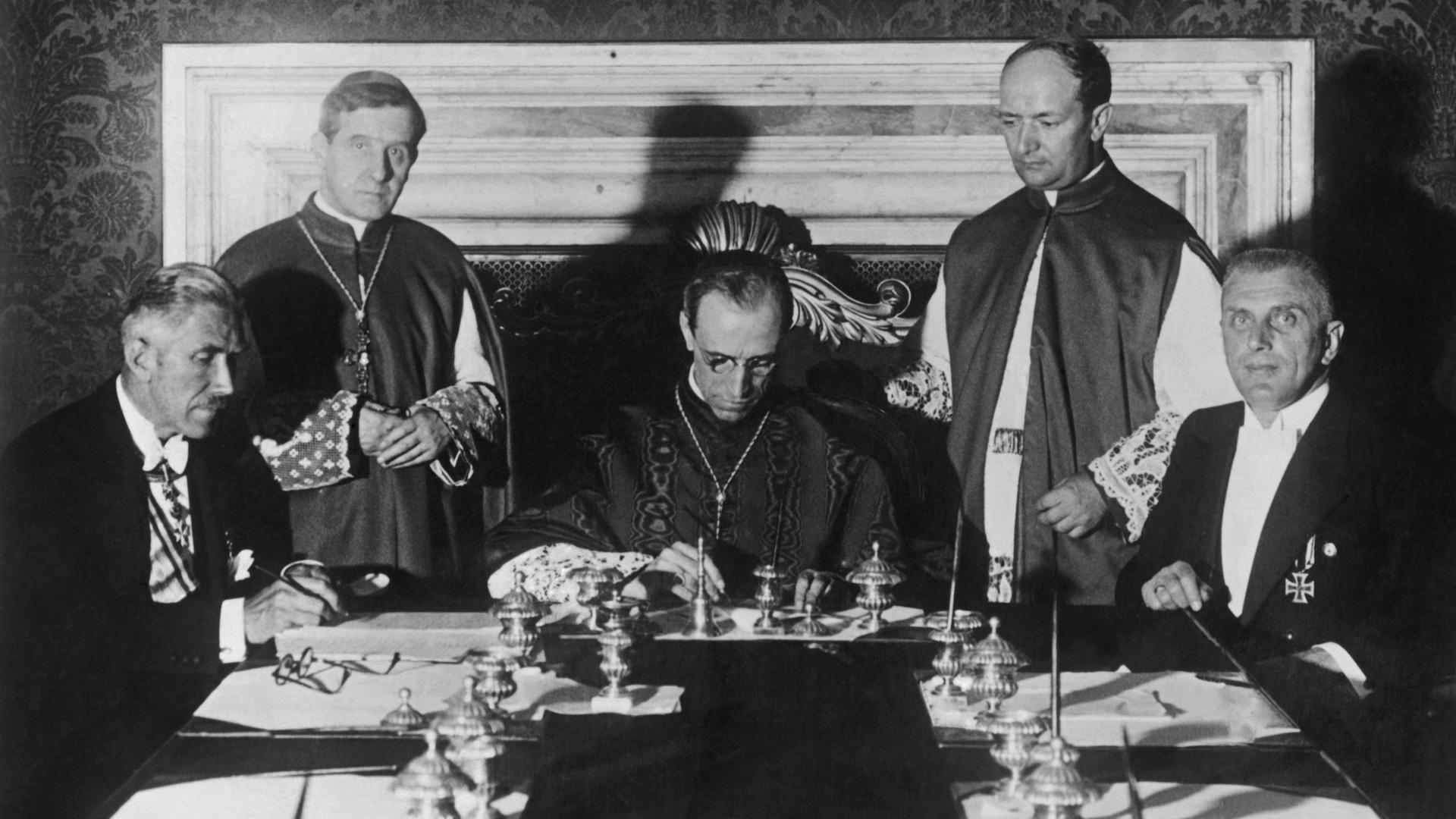
The photograph shows Pope Francis alongside a representative of the Sovereign Military Order of Malta.
image.pngimage.pngimage.pngimage.png
John Roberts, the FISA Court, and the Network of Judicial Influence
The independence of the American judiciary is fundamental to the constitutional system. Judges are expected to interpret and apply the law without political interference, personal favoritism, or allegiance to outside organizations. Yet the process by which judges reach positions of authority involves political appointments, institutional relationships, professional networks, and decisions that receive relatively little public attention.
At the center of one particularly important arrangement stands Chief Justice John Roberts.
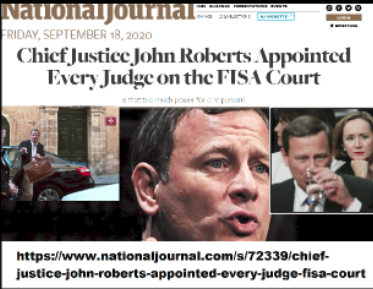
Beyond presiding over the Supreme Court, Roberts possesses a lesser-known statutory responsibility: selecting the federal judges who serve on the Foreign Intelligence Surveillance Court, commonly called the FISA Court.
This specialized tribunal considers government requests for certain intelligence surveillance operations, including applications involving sensitive national-security investigations.
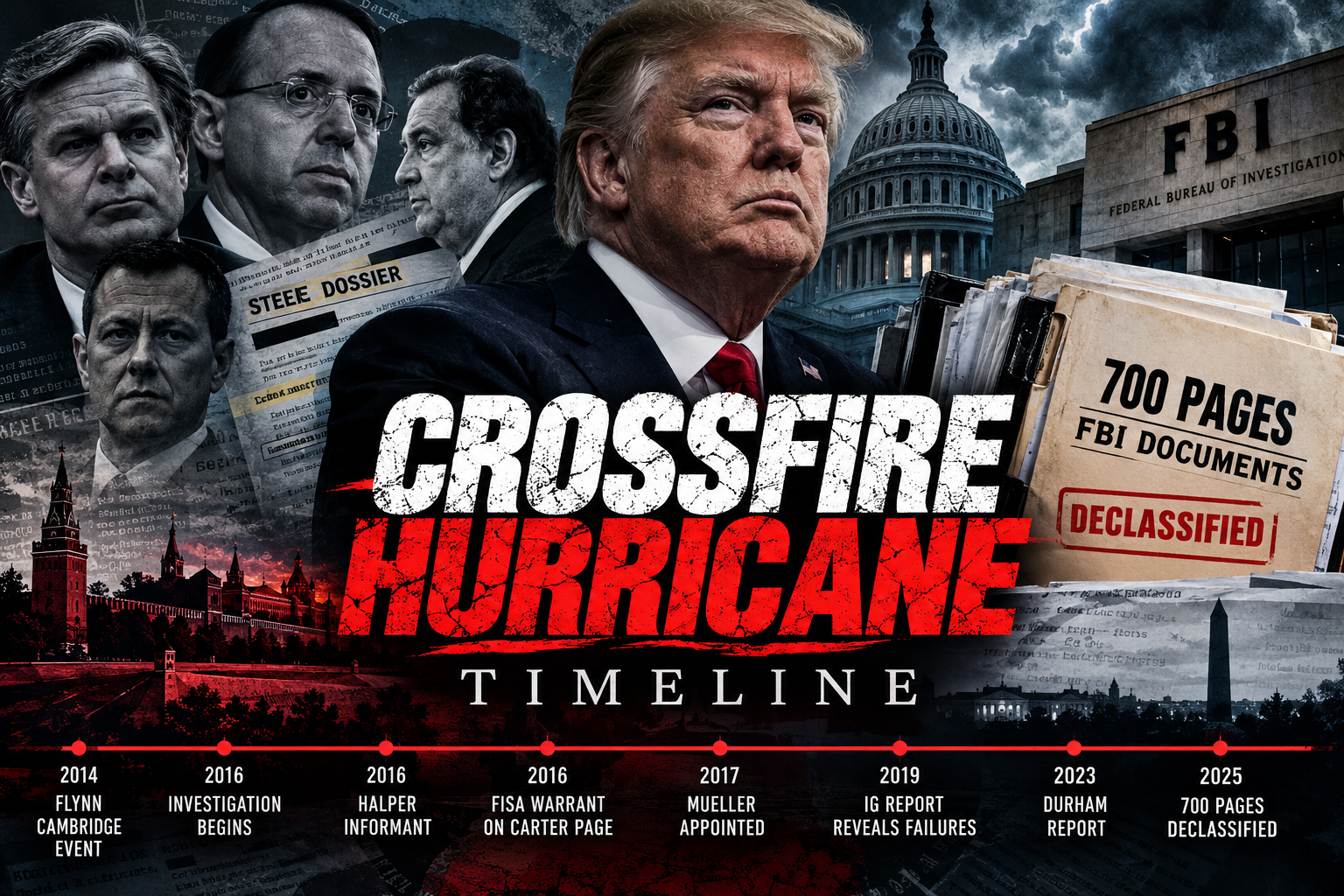
In 2013, reporting and independent analysis drew attention to the concentration of appointment authority in the chief justice's office. More than a decade later, questions about surveillance oversight gained additional relevance through revelations concerning the FBI's Crossfire Hurricane investigation and surveillance of former Trump campaign adviser Carter Page.
Then, on May 29, 2025, President Donald Trump publicly criticized the Federalist Society and conservative legal strategist Leonard Leo, the same judicial-selection network that had helped shape his first administration's federal judicial appointments.
These developments raise important questions about judicial independence, institutional influence, and accountability.
The central issue is not whether a secret organization has been proven to control the courts. It is whether the documented concentration of appointment authority, political influence, and weaknesses in surveillance oversight creates risks that deserve greater public scrutiny.
The Chief Justice's Power Over the FISA Court
The Foreign Intelligence Surveillance Court was established under the Foreign Intelligence Surveillance Act of 1978. Its purpose is to provide judicial review of certain government intelligence-surveillance requests.
Unlike ordinary federal courts, which generally operate through public proceedings, much of the FISA Court's work occurs in classified settings.
That secrecy has a legitimate national-security purpose. Intelligence applications may involve classified methods, intelligence sources, foreign governments, and ongoing investigations.
However, secrecy also limits opportunities for public oversight.
Under 50 U.S.C. § 1803, the Chief Justice of the United States designates eleven federal district court judges to serve on the FISA Court. Those judges must represent at least seven judicial circuits, and each may serve for a maximum of seven years.
The Chief Justice also selects three judges to serve on the Foreign Intelligence Surveillance Court of Review, which considers certain appeals.
These assignments do not require a separate presidential nomination or Senate confirmation. The judges have already been appointed and confirmed to their regular federal judicial positions.
The significance is straightforward: one official holds substantial authority over the membership of a court responsible for reviewing some of the federal government's most sensitive surveillance applications.
U.S. Code
The 2013 investigation into Roberts' appointments
In August 2013, the composition of the FISA Court became a subject of national attention.
An analysis by Russell Wheeler of the Brookings Institution examined Roberts' judicial appointment responsibilities and reported that ten of the eleven then-serving FISA Court judges had originally been appointed to federal judgeships by Republican presidents.
All eleven had been selected for FISA Court service by Roberts.
Wheeler cautioned that political affiliation based on the appointing president is an imperfect measure of judicial philosophy. His broader examination of Judicial Conference committee appointments revealed a more complicated pattern, with experience, eligibility, and institutional needs also influencing appointments.
Brookings
Nevertheless, the concentration of FISA Court appointments in the chief justice's office raises a legitimate governance question.
Should a single Supreme Court justice possess this level of discretionary appointment power over an intelligence tribunal whose proceedings are largely inaccessible to the public?
There is an important distinction between the lawful exercise of appointment authority and evidence of misconduct. Roberts' responsibility is explicitly authorized by federal statute. The composition of the 2013 court, standing alone, does not establish that the appointed judges were biased or improperly influenced.
But the arrangement makes transparency surrounding appointment criteria especially important.
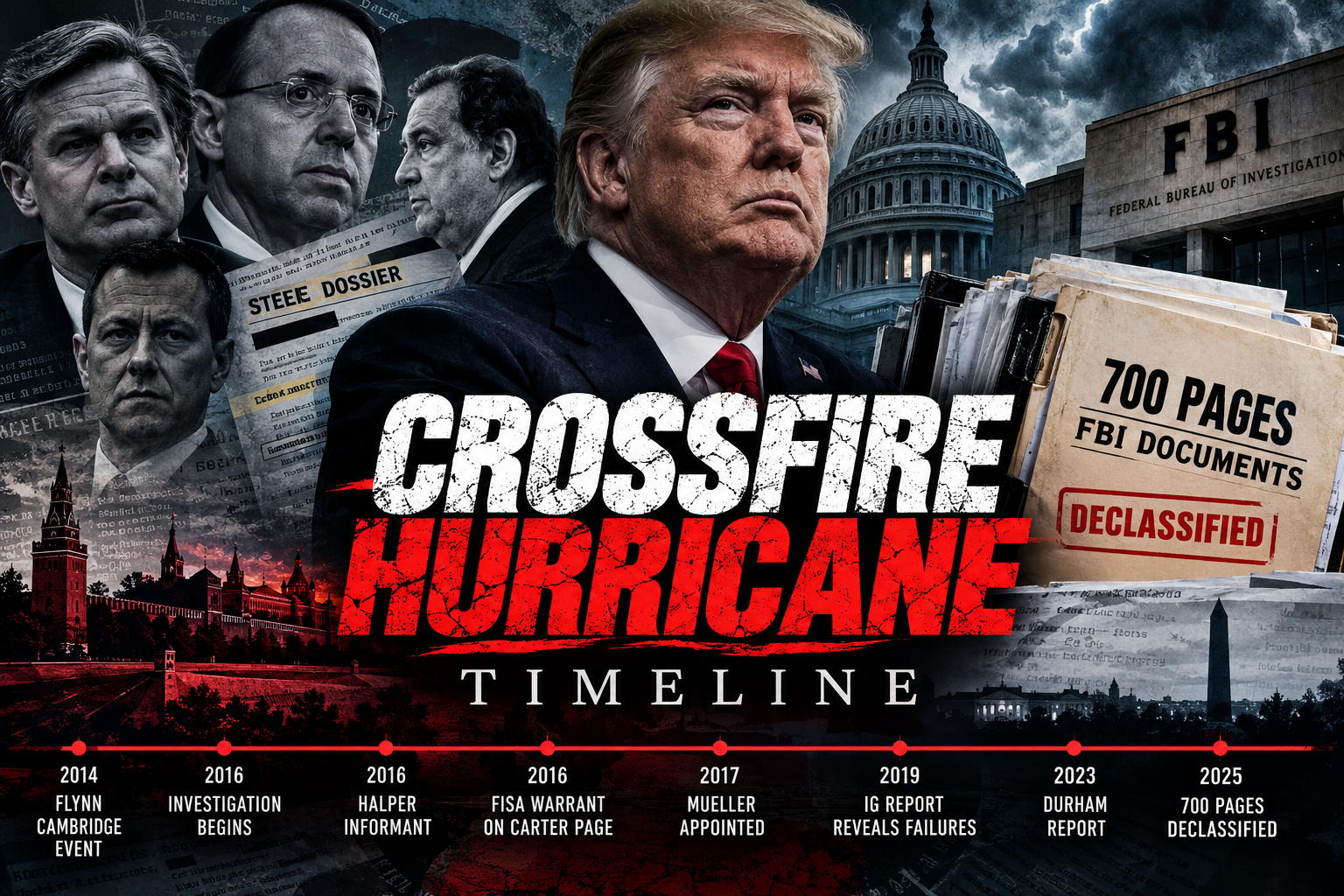
The debate over FISA Court oversight intensified following the FBI's investigation into possible connections between individuals associated with Donald Trump's 2016 presidential campaign and Russian election interference.
The investigation, known as Crossfire Hurricane, began in July 2016.
One of its most controversial components involved surveillance applications targeting Carter Page, a former Trump campaign adviser.
The FBI obtained an initial FISA surveillance order in October 2016 and subsequently sought renewals.
In December 2019, the Department of Justice Office of Inspector General released a detailed examination of the FBI's handling of these applications.
Its findings were serious.
DOJ INSPECTOR GENERAL — DECEMBER 2019
17
Significant errors or omissions
Identified in the Carter Page FISA applications.
The Inspector General also identified additional failures involving the FBI's factual-verification procedures.
Department of Justice
These errors included inaccurate statements, omitted information, and failures to communicate relevant investigative developments to Justice Department attorneys responsible for presenting surveillance applications.
According to the Inspector General, the combined errors made the evidence supporting probable cause appear stronger than it actually was.
The report also found inadequate compliance with the FBI's Woods Procedures, which are intended to ensure the factual accuracy of surveillance applications.
The consequences extended beyond a single investigation.
When a surveillance court operates primarily through classified proceedings, judges depend heavily on the completeness and accuracy of the material submitted by government attorneys and investigators.
If investigators omit contradictory evidence or present misleading information, the court's ability to perform independent review can be compromised.
The Inspector General did not conclude that every error was intentional. Its report distinguished documented procedural failures from allegations that had not been substantiated.
That distinction matters.
The Carter Page episode demonstrated significant weaknesses in the government's surveillance application process. It did not, by itself, establish that Chief Justice Roberts directed the investigation or that a coordinated judicial conspiracy existed.
Yet it exposed a serious structural vulnerability: secret judicial proceedings depend on rigorous verification, disclosure, and institutional accountability.
Leonard Leo and the Federalist Society's Role in Judicial Selection
A second dimension of the judicial-influence debate concerns the organizations and individuals involved in identifying, evaluating, and promoting candidates for federal judgeships.
Among the most influential figures in conservative legal politics is Leonard Leo.
Leo served for years in senior leadership at the Federalist Society and became a prominent adviser to Republican administrations on judicial appointments.
The Federalist Society is a legal organization associated with conservative and libertarian approaches to constitutional interpretation, including originalism and textualism.
Membership or participation in the organization does not establish misconduct. Its influence primarily operates through professional relationships, legal scholarship, networks of lawyers and judges, and engagement in judicial nomination debates.
Leo's role, however, has extended well beyond ordinary membership.
A 2023 ProPublica investigation documented Leo's relationships with conservative donors, legal organizations, political leaders, and judicial nomination efforts. The reporting described a substantial network capable of influencing which prospective judges receive attention and support.
ProPublica
Academic research has also documented the Federalist Society's prominence in Republican judicial selection. Research published in the Journal of Law and Courts examined the relationship between Federalist Society affiliation and federal judicial nominations, including its importance during Trump's first administration.
Cambridge Core
This is not evidence that Leo possesses legal authority to command federal judges after their confirmation.
It is evidence that private political and legal networks can exercise considerable influence over the process through which judicial candidates are identified and promoted.
The distinction between influencing judicial selection and controlling judicial decisions is essential.
The former is extensively documented. The latter requires specific evidence about particular conduct or cases.
Trump Publicly Turns Against Leonard Leo
On May 29, 2025, President Trump issued a lengthy Truth Social statement following a dispute over the legality of his administration's tariffs.
The immediate controversy involved the U.S. Court of International Trade, which had ruled against major elements of his tariff policy, and subsequent proceedings before the U.S. Court of Appeals for the Federal Circuit.
Rather than limiting his criticism to the legal ruling, Trump attacked the institutions and advisers involved in recommending federal judicial nominees.
Trump acknowledged that, upon entering Washington during his first administration, he had relied on the Federalist Society as a source of judicial recommendations.
He then criticized Leonard Leo and suggested that Leo exercised extraordinary influence within the federal judiciary.
Importantly, Trump expressed doubt about the full extent of the influence he was alleging.
His statement represented a striking public break with a network that had helped shape his first administration's judicial appointments.
The significance of Trump's remarks lies partly in the acknowledgment that an external legal network played an important role in his administration's judicial-selection process.
This was not a previously unknown relationship. Conservative legal organizations had openly participated in judicial nomination discussions for years.
What made the statement noteworthy was Trump's public accusation that the network had recommended judges whose decisions he considered unacceptable.
It also illustrated the tension between judicial independence and the political expectations sometimes attached to judicial appointments.
A president may nominate a judge expecting a particular judicial philosophy. But once confirmed, federal judges have a constitutional obligation to decide cases according to law rather than presidential preference.
A ruling against the president who nominated a judge is not, by itself, evidence of disloyalty or corruption. It can be evidence that the judicial system is functioning independently.
Conversely, questions about conflicts of interest, undisclosed relationships, or inappropriate outside influence should not be dismissed merely because they concern judges or respected legal organizations.
Both principles are necessary for meaningful accountability.
The Vatican, Knights of Malta, and Claims of Religious Influence
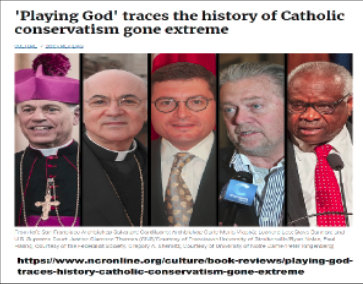
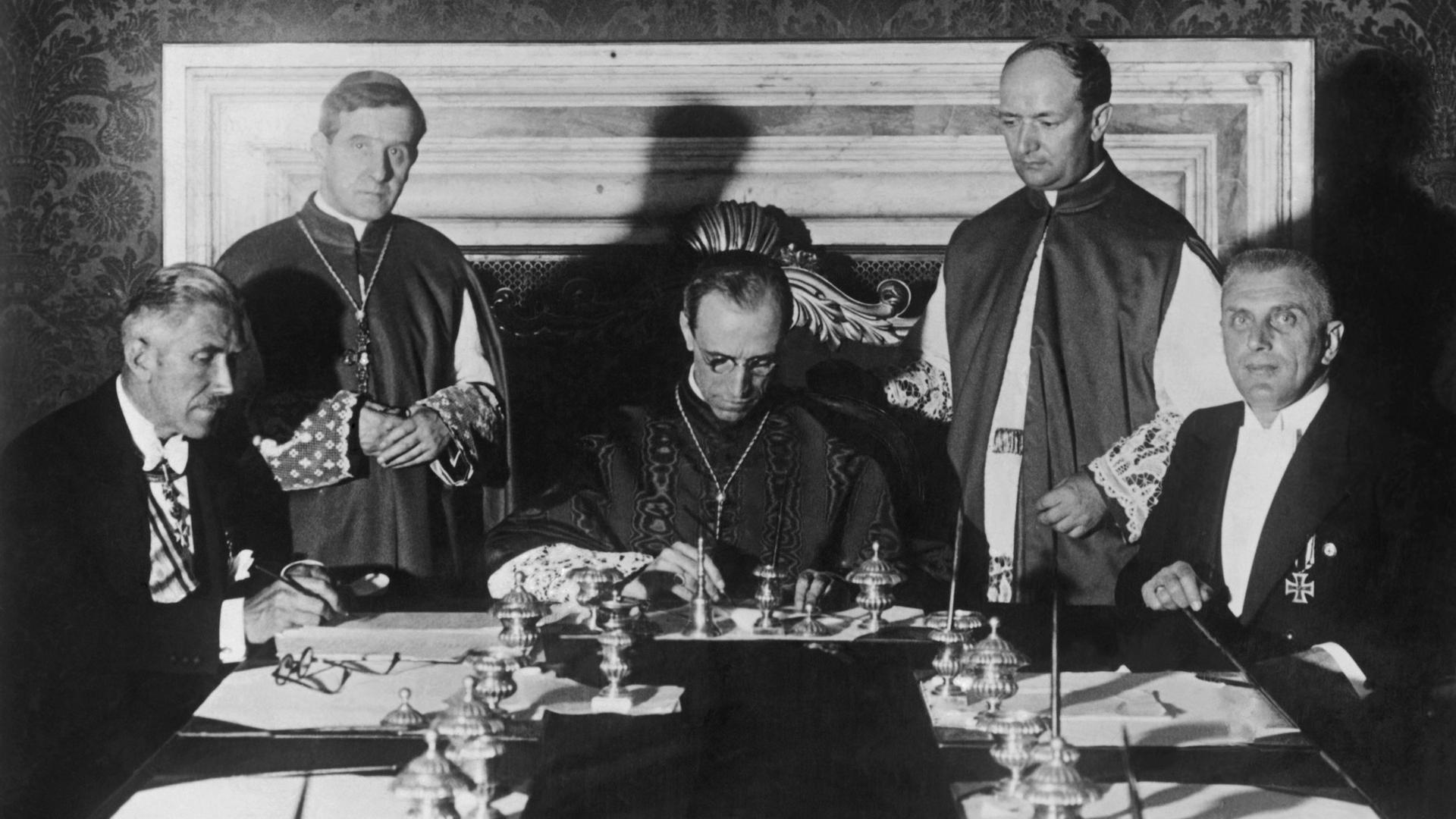
Another element frequently introduced into discussions of judicial influence involves religious organizations, particularly Catholic institutions with longstanding relationships to political and legal elites.
These include the Vatican, the Society of Jesus, and the Sovereign Military Order of Malta.
The Knights of Malta is a centuries-old Catholic religious and charitable order with a distinctive international status and diplomatic relationships.
Its membership has historically included prominent individuals from European aristocratic, political, and professional circles.
In January 2017, the order experienced a major leadership dispute involving Pope Francis and Grand Master Matthew Festing.
The dispute followed the removal of Grand Chancellor Albrecht von Boeselager and disagreements over the administration of the order's humanitarian operations.
On January 24, 2017, Festing submitted his resignation following a meeting with Pope Francis. The order subsequently accepted the resignation, and the Vatican participated in a process intended to stabilize its leadership.
Contemporary Reuters reporting and statements from the order documented the conflict.
The Economist subsequently published an explanation titled Why the Pope Has Taken Control of the Knights of Malta, examining the Vatican's involvement in the order's internal governance.
BusinessGhana
These events demonstrate that a serious internal conflict occurred within a prominent Catholic institution.
They do not demonstrate that the Knights of Malta controls the American judiciary.
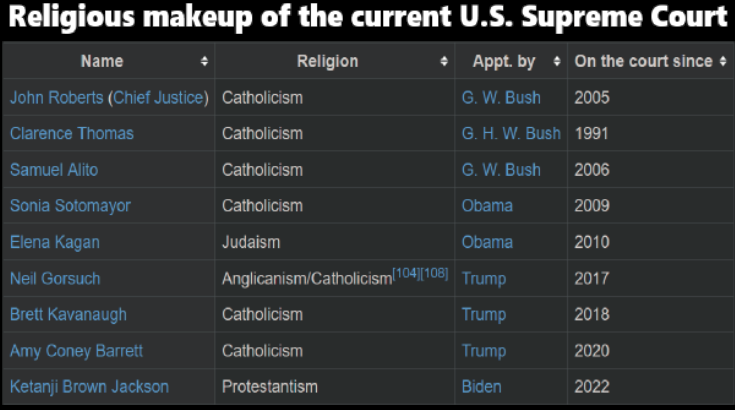
Similarly, the fact that several Supreme Court justices have Catholic backgrounds does not establish institutional control by the Vatican.
Religious affiliation, private association, professional relationships, and coordinated political conduct are distinct matters.
A credible investigation must distinguish among them.
For example, documentation showing that a judge attended an event sponsored by a religious organization might establish a professional or social relationship. It would not independently establish that the organization influenced a particular judicial ruling.
Proving improper influence would require stronger evidence, such as undisclosed financial relationships, communications directing judicial conduct, conflicts of interest, or coordinated attempts to affect specific cases.
Without such evidence, claims of religious control remain allegations.
The Overlooked Power of Judicial Administration
The FISA Court is only one area in which the chief justice exercises responsibilities beyond deciding Supreme Court cases.
As presiding officer of the Judicial Conference of the United States, the chief justice also occupies a central position in the federal judiciary's administrative structure.
The Judicial Conference oversees major administrative functions, including judicial policy, budgeting, procedural-rule recommendations, and aspects of judicial governance.
The chief justice appoints members and chairs of numerous Judicial Conference committees.
These committees can influence how the federal judiciary operates, even when their work does not involve deciding individual lawsuits.
In his 2013 analysis, Russell Wheeler examined Roberts' Judicial Conference committee appointments and emphasized that their institutional importance deserved attention alongside appointments to the FISA Court.
Brookings
This distinction reveals a larger issue.
Public debates about judicial influence usually focus on individual Supreme Court decisions, presidential nominations, and confirmation hearings.
Far less attention is paid to the administrative arrangements governing the judiciary.
Yet those arrangements affect who serves in important judicial positions, how courts establish procedures, and how institutional oversight develops.
These powers are legally established and do not imply wrongdoing.
They nevertheless demonstrate why meaningful judicial accountability must extend beyond the Supreme Court's published opinions.
Judicial Independence Versus Institutional Accountability
Any investigation into the federal judiciary must confront two competing concerns.
The first is the need to protect judicial independence.
Federal judges cannot perform their constitutional duties if they are expected to issue decisions favorable to the political officials responsible for their appointments.
A president's dissatisfaction with a judicial ruling does not establish judicial misconduct.
The second concern is the need for accountability.
Judicial independence does not require treating the judiciary as immune from public scrutiny.
Questions about judicial ethics, appointment procedures, conflicts of interest, financial disclosures, and surveillance oversight are appropriate subjects of investigative reporting.
The Carter Page surveillance controversy demonstrates the importance of this second principle.
Although the Justice Department Inspector General documented significant problems with the government's submissions, the FISA process relied on the court receiving accurate information from intelligence officials.
The initial Carter Page order was approved by FISA Court Judge Rosemary Collyer on October 21, 2016. Different judges considered the subsequent renewal applications.
Civil Rights Litigation Clearinghouse+1
This record provides specific decisions, dates, and responsible institutions for investigators to examine.
It does not support treating the chief justice's appointment authority as proof that he personally controlled the underlying surveillance decisions.
The relevant questions are more precise: Were the applications sufficiently scrutinized? Were contradictory facts disclosed? Were procedural safeguards effective? And did subsequent reforms adequately address the failures identified?
Those questions can be investigated through court orders, Inspector General findings, congressional records, and agency procedures rather than speculation about concealed allegiances.
What Should Be Investigated Next?
The public record supports several avenues of further investigation.
First, the FISA Court's appointment process deserves continued scrutiny. Federal law establishes the chief justice's authority, but a complete assessment would examine appointment criteria, historical selections, qualifications, and whether additional transparency would strengthen public confidence.
Second, the Carter Page surveillance applications demonstrate the need for independent evaluation of the government's disclosure obligations and the safeguards designed to protect Americans from improper surveillance.
Third, the role of private organizations in federal judicial nominations should be examined through documented funding arrangements, communications, public advocacy, and relationships with government officials.
Fourth, judicial ethics and disclosure practices should receive consistent scrutiny regardless of the political ideology or religious background of the officials involved.
Finally, claims connecting religious institutions to American judicial decisions should be evaluated individually, with attention to evidence rather than imagery or association.
These are not questions limited to one political party.
The institutional powers exercised by the chief justice exist regardless of which president occupies the White House.
Similarly, the potential for improper political influence exists wherever wealthy donors, influential advocacy organizations, government officials, and judicial institutions interact without adequate transparency.
Conclusion: The Evidence Matters More Than the Allegations
The documented record establishes several consequential facts.
Chief Justice John Roberts exercises statutory authority over the selection of judges serving on the Foreign Intelligence Surveillance Court.
The Justice Department Inspector General identified substantial errors and omissions in the government's Carter Page surveillance applications.
Leonard Leo and the Federalist Society have played prominent roles in conservative judicial nomination networks.
President Donald Trump publicly criticized that network in May 2025, expressing dissatisfaction with judicial recommendations and questioning the influence of one of its leading figures.
The Vatican also exercised documented authority during a 2017 leadership dispute involving the Knights of Malta.
These facts deserve examination, but they do not automatically establish a single coordinated network controlling American courts.
There is a difference between documented influence, concentrated institutional authority, and proven corruption.
Understanding that difference is essential to any serious investigation.
The strongest case for greater judicial accountability does not depend on an unverified theory of secret control. It rests on the public record: concentrated appointment powers, powerful nomination networks, documented surveillance failures, and legitimate concerns about transparency.
The American public has a compelling interest in understanding how judges are selected, how surveillance powers are reviewed, how outside interests seek to influence the legal system, and whether existing safeguards adequately protect constitutional rights.
Those questions deserve answers grounded in records, testimony, and verifiable evidence.
Judicial independence and judicial accountability are not opposing principles. A trustworthy constitutional system requires both.
In the May 29 post, Trump explicitly named Leonard Leo and criticized the Federalist Society for its recommendations regarding federal judicial appointments.
Trump also alleged that Leo had influence over judges and Supreme Court justices, while acknowledging uncertainty about the extent of that influence.
Follow the sources, not just the headline.
Keep the timeline and context in view.
ABOUT THIS RECORD
QNotables newsroom
Research, source tracking, and public-record context for readers who want the full picture.


COMMENTS
No comments yet. Be the first to comment!
You must be logged in to leave a comment.
LOG IN TO COMMENT